

Sports Betting Payment Processor: What Cappers Need to Know
Looking for a sports betting payment processor? Learn why processors restrict betting businesses, what to look for, and where a merchant of record fits.
Trevor Greene
· 9 min read
By the KeepPicks team. Published October 2026.
If you sell sports picks, getting paid is harder than it looks. Many payment providers treat betting-related businesses differently from other online sellers, and cappers often find out the hard way: an application that stalls, a reserve held back from payouts, or an account that gets paused with subscribers waiting. This guide explains why a sports betting payment processor is different from a standard one, what to look for, and where a merchant of record fits in.
If you're still deciding how to build your picks business, start with our guide on how to sell sports picks online.
Why payment processors can be strict with betting-related businesses
There's no single rule, and every provider sets its own terms. But a few patterns come up again and again.
- Gambling often appears on restricted or prohibited lists. Payment providers publish lists of businesses they won't serve or only serve with approval, and gambling-related activity is commonly on them. Whether selling picks counts as gambling under a given provider's terms is up to that provider, so don't assume either way.
- Regulation varies by location. Betting laws differ from state to state and country to country, and providers don't want exposure to shifting rules.
- Dispute risk. Subscriptions and recurring billing can lead to chargebacks, and providers watch dispute rates closely.
- New businesses have no track record. A capper just starting out has no processing history, which makes underwriting harder.
The result is that a capper can be approved by one provider and turned away by another, or approved and then reviewed again later. Always read the provider's terms and ask direct questions before you build on it.
What "high risk payment processing" usually means
When a provider classifies a business as high risk, the terms are typically tougher. According to industry explainers such as Stripe's guide to high-risk merchant accounts, that can include:
- Higher fees: setup, monthly and per-transaction costs can all be higher.
- Reserves: a percentage of your sales may be held back for a period to cover chargebacks.
- Slower settlement: funds can take longer to reach you, which affects cash flow.
- Stricter underwriting: more documents, a risk review and sometimes a credit check.
- Ongoing monitoring: your dispute rate and transaction patterns are tracked.
- Tighter contracts: longer terms and penalties for leaving early.
None of this means selling picks is off limits. It means you should compare the full cost and the conditions, not just the headline rate.
What are chargebacks, and why do they matter to cappers?
A chargeback happens when a buyer disputes a charge with their card issuer instead of asking you for a refund. The bank can reverse the payment, and the seller is usually charged a fee on top of the lost sale. Providers watch dispute rates closely, and a high rate can lead to reserves, tighter terms, or a paused account.
Subscriptions are especially prone to this. A buyer forgets they signed up, doesn't recognize the charge on their statement, or can't find how to cancel, and disputes it with their bank. Most chargebacks can be prevented with a few habits:
- Make cancellation easy. A buyer who can cancel in a minute rarely needs a dispute.
- Be clear about what you sell. Describe your plans, prices and renewal dates plainly.
- Respond to buyers quickly. A fast refund often costs less than a dispute.
- Use a recognizable name so the charge makes sense on a statement.
Your options to accept payments for picks
Cappers usually end up choosing between three routes.
| Option | How it works | Watch out for |
|---|---|---|
| Standard payment processor | You open an account and take payments directly | Your business may be restricted or reviewed, and you handle disputes and refunds |
| High-risk merchant account | A provider that specializes in higher-risk businesses | Often higher fees, reserves and longer contracts |
| Merchant of record | A platform acts as the legal seller and pays you out | Check what it covers, how payouts work and how fees are set |
No option is best for everyone. If you want full control of your own payment setup, a processor or merchant account can make sense. If you'd rather not build and manage that yourself, a merchant of record is worth a close look.
What to look for in a sports betting payment processor
Use this checklist before you commit to any provider:
- Does it work with sports betting content? Ask directly and get the answer in writing.
- What is the total cost? Count setup fees, monthly fees, per-transaction fees, reserves and chargeback fees.
- How and when will you be paid? Ask about payout timing and any holds.
- Who handles refunds, disputes and chargebacks? Ask what the provider covers and what falls on you.
- What are the contract terms? Look for long commitments and cancellation penalties.
- How easy is checkout for your buyers? Every extra step costs you sales.
- How do buyers cancel? A confusing process leads to disputes.
- Can you reach a real person? You'll want one if something goes wrong.
Where a merchant of record fits
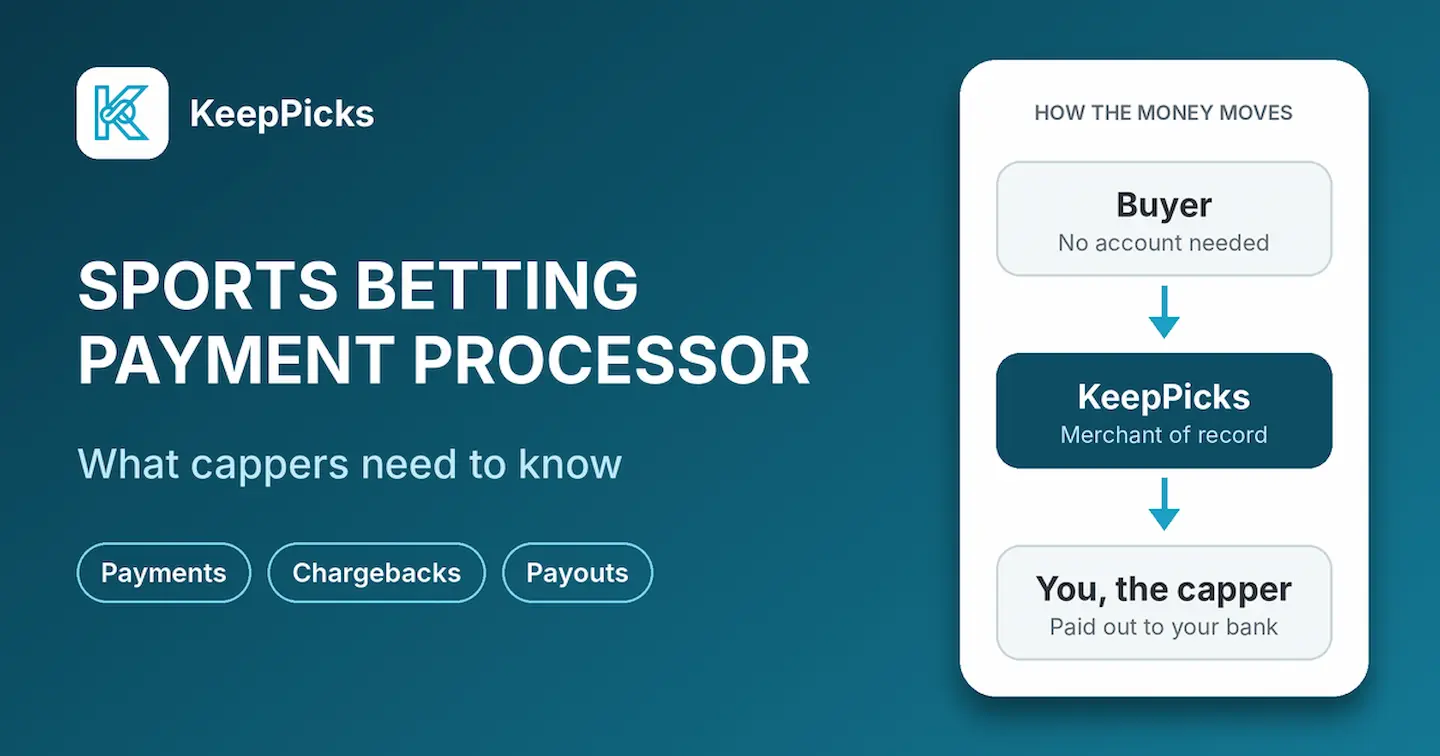
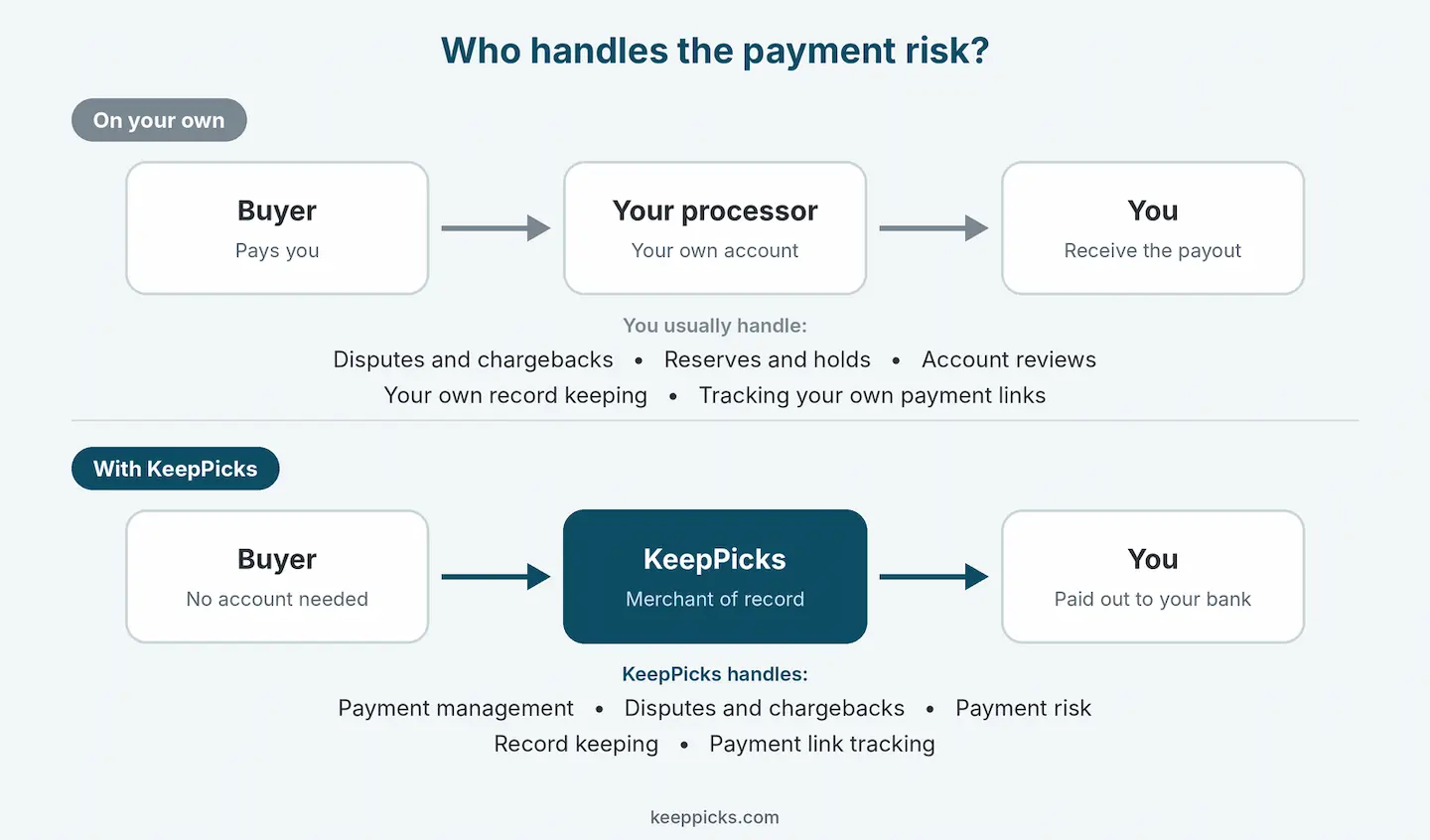
A merchant of record is the business that is legally the seller in a transaction. Your buyer pays the merchant of record, it handles the payment side of the sale, and you receive your earnings as a payout. That can mean less setup and less to manage than running your own processor.
We explain how this works, how it compares with a payment processor, and when you might not need one in our guide to merchant of record for sports picks.
How KeepPicks handles chargebacks and payment risk
When you sell through KeepPicks, KeepPicks is the merchant of record, so we take care of the risk and payment management that come with the sale. That includes handling disputes and chargebacks, so you aren't the one answering to a card issuer or managing your own processor account. You don't have to learn how reserves, dispute deadlines or monitoring thresholds work. That's our job, and it leaves you free to focus on your picks.
Subscribers can also manage or cancel their purchases themselves, which helps prevent disputes before they happen.
How KeepPicks helps cappers save on fees
KeepPicks is built as a merchant of record for sports cappers, with one goal: more of what you earn stays with you. Generic creator platforms take a serious cut of every sale, and tools you don't need can add up. Here is how KeepPicks is designed to keep your costs down:
- One platform instead of a stack of tools. A storefront, payment links, Telegram delivery, subscriber monitoring and payouts live in one dashboard, so you aren't paying separately for each piece.
- Built for cappers, not for everyone. You pay for the tools cappers actually use.
- We handle the payment risk. Disputes and payment management are on our side, so you aren't paying for separate tools or spending time on chargeback paperwork.
- Clear numbers. You can track your sales and see which products earn the most.
- No account needed for buyers. Buyers check out from your storefront or payment link, and fewer abandoned checkouts means fewer lost sales.
Here's why a few percentage points matter. These figures are illustrations of how fees add up, not KeepPicks rates:
| Monthly sales | 5% in fees | 10% in fees | 15% in fees | 20% in fees |
|---|---|---|---|---|
| $1,000 | $50 | $100 | $150 | $200 |
| $5,000 | $250 | $500 | $750 | $1,000 |
| $10,000 | $500 | $1,000 | $1,500 | $2,000 |
On $5,000 in monthly sales, the gap between 10% and 20% is $500 every month. Compare total cost, not just the advertised rate, and ask any provider what is included. Want to know what you'd pay with KeepPicks? Contact our team and your account manager will walk you through it.
How buyers are treated on KeepPicks
Buyers don't need an account to purchase. KeepPicks keeps buyer data private, and our Privacy Policy explains how it is handled. Subscribers can manage or cancel their purchases at any time, which builds trust with buyers and reduces disputes.
You can read more about who we are and why we built KeepPicks.
Frequently asked questions
What is a sports betting payment processor?
It's a payment provider that works with betting-related businesses, such as cappers selling picks. Some providers restrict these businesses, so cappers often look for one that explicitly accepts them.
Why is payment processing harder for sports cappers?
Many providers list gambling-related businesses as restricted, and betting rules vary by location. Subscriptions can also lead to disputes. The terms differ by provider, so always read them first.
What is high risk payment processing?
It's payment processing for businesses a provider considers higher risk. It typically comes with higher fees, reserves, slower settlement and stricter applications.
What is a chargeback?
A chargeback is when a buyer disputes a charge with their bank and the payment is reversed. Sellers are usually charged a fee, and too many disputes can lead to reserves or a paused account.
Who handles chargebacks on KeepPicks?
KeepPicks does. As the merchant of record, we manage disputes and payment risk so you can focus on your picks. Contact our team if you want to know more about how it works.
How can I accept payments for picks without my own processor?
A merchant of record can take the payment side off your plate. Read our guide to merchant of record for sports picks for the details.
Is it legal to sell sports picks?
Rules about betting advice and gambling-related businesses vary by state and country. Check the laws where you live and where your buyers are, and talk to a lawyer if you're unsure.
How do I get started with KeepPicks?
Create your free account, then follow the Get Started guide in your dashboard to set up your storefront, pricing plans and Telegram channel.
Ready to get paid for your picks?
You don't need to figure out payment processing on your own. Create your free KeepPicks account, or read our full guide on how to sell sports picks online to plan your next steps.
This article is general information, not legal, tax or financial advice. Sports betting involves risk, and picks are opinions, not guarantees. You must be of legal betting age where you live.